Digital Forensics and Media Integrity
Image Steganography and Digital Manipulation Detection Advancing multimedia forensics through techniques that detect hidden data, digital tampering, and manipulated content, ensuring authenticity and evidential reliability. Bridges AI-based image analysis with forensic validation for combating misinformation and cybercrime.
Steganography | Deepfake detection | Metadata forensics | Image authentication | Forensic AI
MATADOR: a magic matrix-based framework for tamper detection and image recovery
- Project URL: Click here
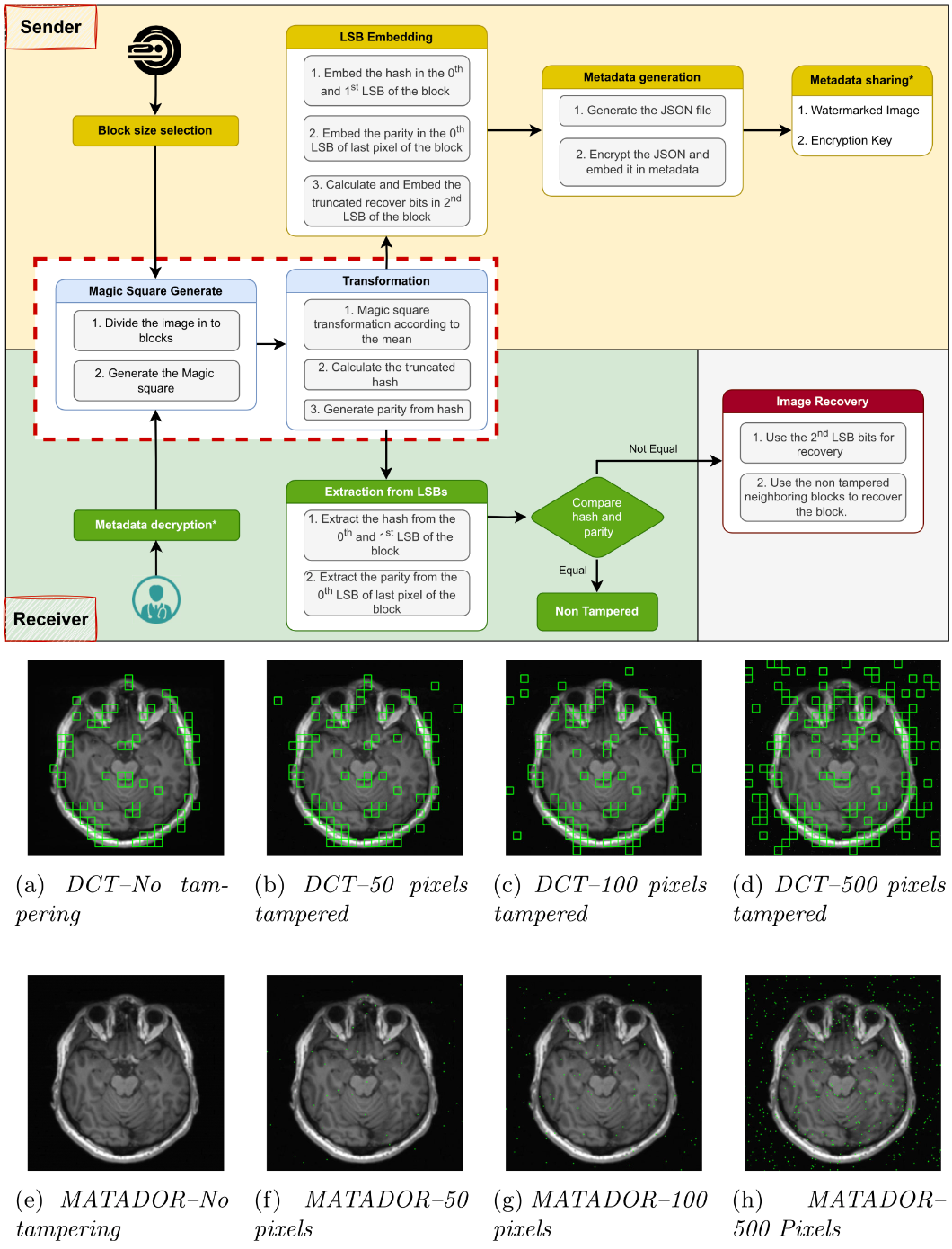
Ensuring the integrity and authenticity of digital medical images is crucial for healthcare security and digital forensics, as image tampering can have serious consequences. Traditional methods often struggle to detect subtle, localized manipulations, leaving critical vulnerabilities. In this work, we propose MATADOR (Magic Matrix-Based Adaptive Tamper Detection and Recovery), an innovative image authentication framework utilizing block-based transformations based on magic square matrices for forensic analysis. By calculating each block’s mean value from the first five most significant bits (MSBs) of the pixel values, one of eight unique transformations is applied to the magic matrix. This dynamic approach generates a block-specific hash, linking pixel content to its spatial arrangement and enhancing the traceability of tampered pixel blocks. MATADOR is evaluated against existing forensic techniques, such as Discrete Cosine Transform (DCT) coefficient estimation and fragile watermarking, focusing on tamper localization accuracy and robustness. Experimental results demonstrate that MATADOR significantly improves tamper detection performance while maintaining a lower false positive rate compared to conventional methods. When tested on medical image datasets, MATADOR proves highly effective in accurately identifying tampered regions, highlighting its potential for real-world applications in secure medical imaging.